|
Location: Gauteng and
North West Province
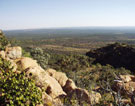
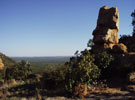
The village itself - the 'burg' - is tiny, little
more than a hamlet nestled among the lovely
foothills of the 'berg', a ridge that runs some 120
kilometres from a point west of Rustenberg to an
area east of Pretoria. The Magaliesberg uplands,
though they rise little more than 300 metres above
the surrounding, flattish countryside, have a
distinctive beauty of their own and, in the more
precipitous parts, even grandeur. The summer rains
are usually generous, and the wooded upper slopes a
source of crystal streams that feed into the
northward-flowing tributaries of the Limpopo River.
The air in the park-like valleys is limpid, warm,
even on winter days.
The Magaliesberg range is barely an hour's drive from
Pretoria and Johannesburg, many of whose residents escape the suffocation of
city life each weekend for the relaxing tranquillity of a region that, beyond
the busy playground of Hartbeespoort Dam, is still largely (on the higher
ground) unspoilt wilderness, a place where vultures wheel elegantly in the
rising thermals, where there is solitude and the splendour of far vistas. Lower
down, on the plains, there are prosperous looking farms, small-holdings and
nurseries that meet the demands of the ever-demanding Witwatersrand market for
peaches, oranges, vegetables and cut flowers.
History
Water, warmth and the lushness these created combined to
attract a profusion of game animals to the region in bygone years. The
elephants, in particular, were a magnet for the early white hunters, who came
with their guns for the killing sport and knew the place as the Cashan
Mountains. They were followed by Voortrekker pastoralists, hardy families bent
on taming and settling the land, which they managed to do following a series of
brutal and ultimately successful clashes with Mzilikazi's impis in the late
1830s. They then renamed the region after the local chieftain Mohali, or Magali.
Later still came the prospectors - men had sensed that there was gold in the
hills long before the massive Witwatersrand deposits were discovered to the
east, and you can still see, here and there, the old stamp mills and machinery
rusting away in the hot middleveld sun. A century and more ago, too, Paul
Kruger, the Transvaal republican president, liked to holiday in the area: the
cottage that houses the village curio shop served as one of the old patriarch's
hunting lodges. And when war came in 1899, Boer and Briton skirmished fiercely
in the hills and valleys, bequeathing posterity some stirring legends of valour
and endurance.
The village and surrounds
A fair number of talented, slightly off-beat and highly
individual people have chosen to make the small centre of Magaliesburg their
permanent home. The arts and crafts thrive in the area, and, together with the
scenic beauty and the scatter of excellent hotels and guest-houses, provide the
thrust of the local tourism drive. Even more artists and craftsmen can be found
at work along the Crocodile River just to the east - an active colony that
includes painters and sculptors, cabinet-makers,, potters, cutlers, weavers and
many others. Art routes have been organized; route maps are available.
Nearest towns
Pretoria lies to the east, Johannesburg to the
south-east, Rustenburg to the west.
Land Claims
The large number of land claims has many farmers worried,
especially since the land claims process is supposed to be concluded in 3 years'
time. Farmers want to know why they're only becoming aware of claims now if the
cut-off for submissions was in 1998.
Are there claims against
any properties advertised on your website?
No and we guarantee that to
be true at time of transfer.
What are the requirements for a claim to be
valid, and is there a cut-off date for
publication?
Claimants must have been deprived of land rights
as a result of racial laws and/or practices
after 1913 without having received fair
compensation. Though there was a cut-off for
submissions, none exist for publication of a
claim.
Do all these conditions have to be met for a claim to be valid?
Yes.
Which body determines the validity of claims?
The Commission on Restitution of Land Rights oversees the process.
Does usage of land only include grazing and habitation rights?
No. The definition of land rights includes usage of land for a period of 10
years or longer. According to the Land Claims Court's interpretation in the
Kranspoort case, this includes grazing, planting, the building of structures or
even grave sites – anything proving people lived there.
Why was 1913 chosen as the cut-off date?
The first national law discriminating against black landowners, the Natives
Land Act, was passed in 1913.
Why is a claim not necessarily invalid if a landowner can trace
ownership back to before 1913?
Since the law acknowledges the usage of land and labour tenant rights, it's
possible that people may have lived on a farm at the same time as the landowner.
Claims arising from such circumstances are valid in terms of the law.
How can farmers ensure that all the
requirements are met?
The Commission has to investigate each claim
before it is published. A report detailing the
Commission's findings is available to the
farmer. One should study the report and gather
info to verify its conclusions.
|
|